Digital Collage

Home Digital Painting Computational Media About Me
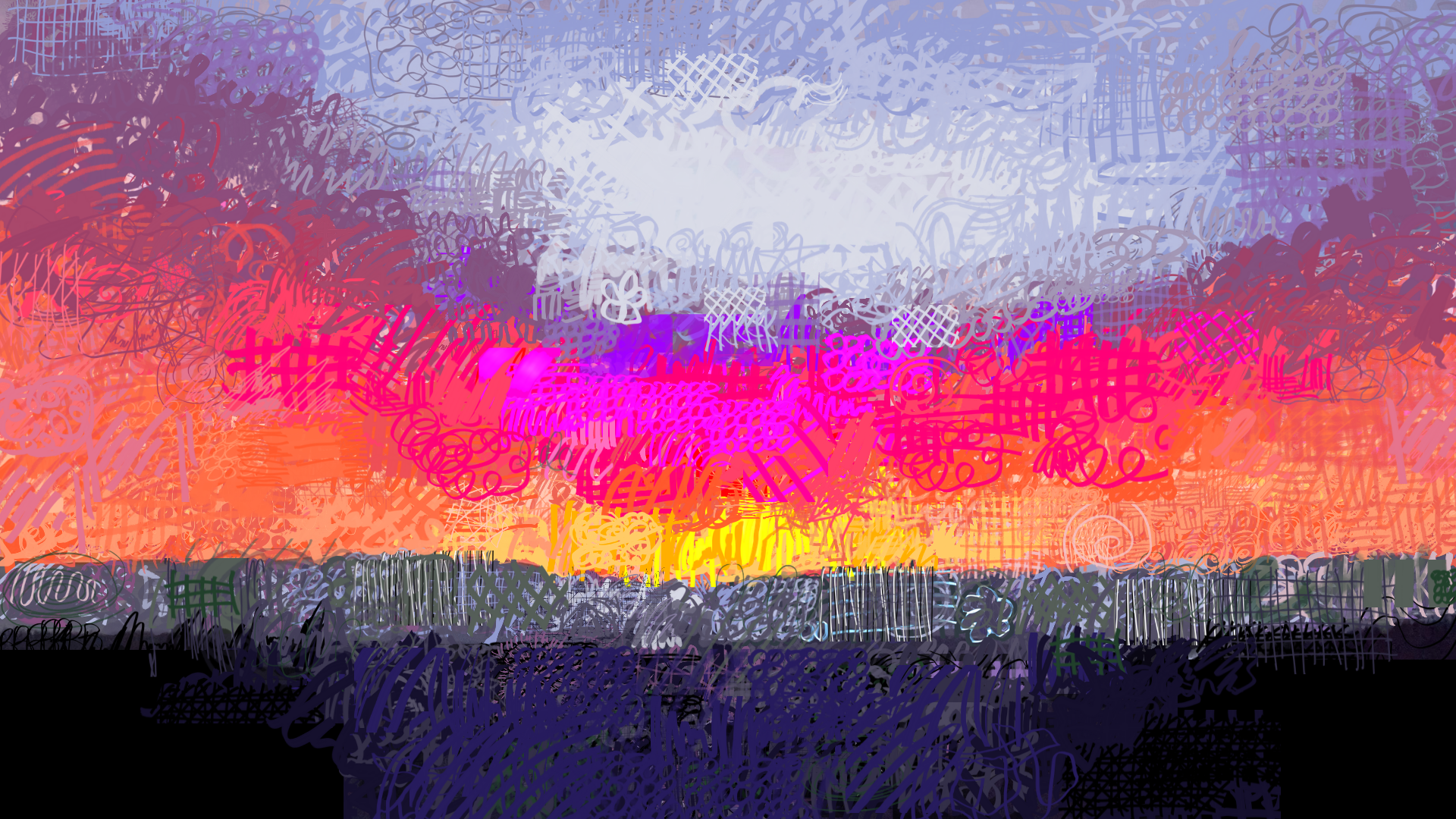
An abstract painting of a sunset in pinks, oranges, and purples

Graffiti Sunrise

Digital image, 2025
I created a large library (1,000+) individually generated mark-making elements created on transparent backgrounds. I used dozens of brush, smear, scrape, and texture variations as standalone PNG files. I then took a photograph I had taken of a sunset, and begin to digitally collage the marks into the frame, roughly using the original photograph's strata and color palette. I digitally layered the marks I had made, arranging them in horizoorigintal bands to establish a gradient shift from warm oranges and reds to cooler violets and blues. Rather than blending with a brush tool, I relied on opacity adjustments, layering order, and overlap to create transitions between color zones. The glow at the horizon emerges through density — more concentrated, brighter marks placed lower in the composition — while upper areas become increasingly sparse and cooler in tone. The final image is the result of cumulative layering, transparency control, and careful color sequencing across thousands of individual elements.
An abstract digital collage depicting a woman's face

Sometimes I Fall Apart II

Digital image, 2025
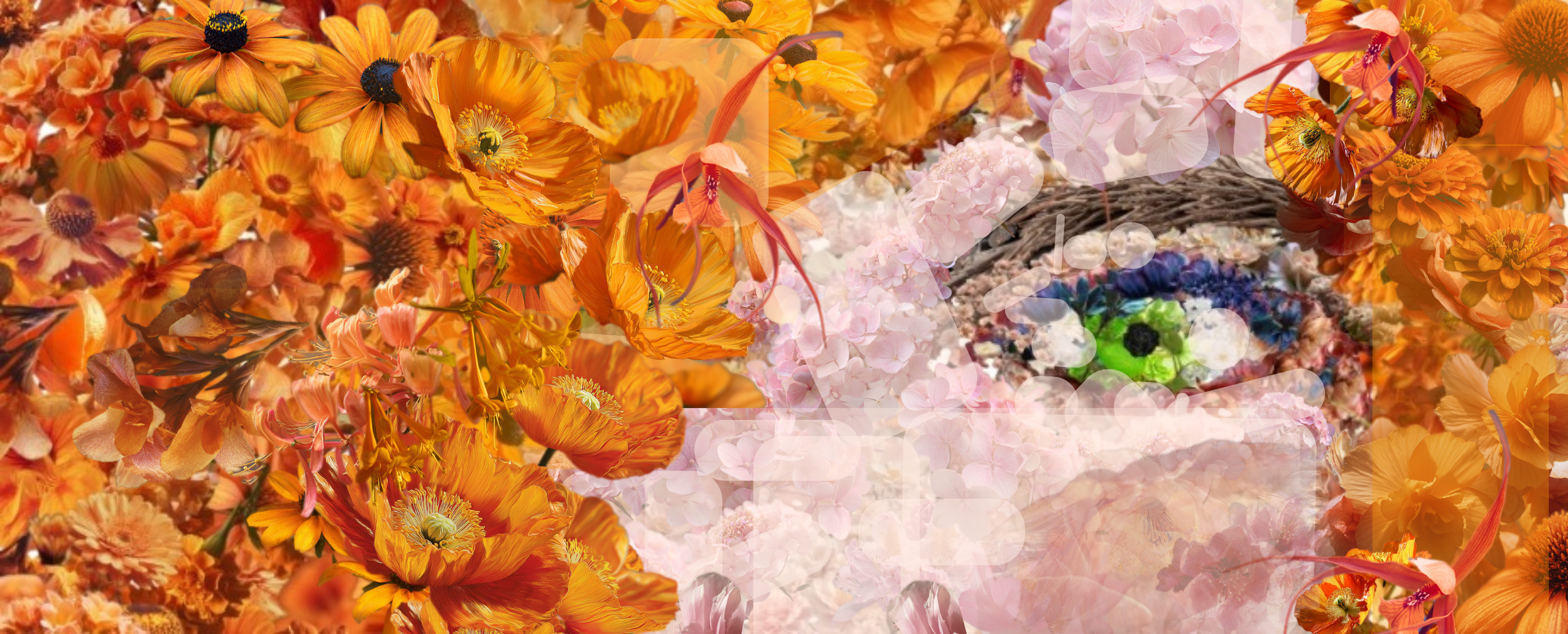
I began with a selfie. I ran it through an AI tool that identified the hex codes that were prominent in my image, creating my personal color palette. Next, I mixed those hex codes with prompts focused on my favorite flowers and created 700 images of botanical photographs on Midjourney in my skin, hair, and eye colors. Then, I wrote a Python script to remove the background of all of the images, so they all became cut-out flowers. Then, I hand-placed them into a digital collage, using my original selfie as a reference.

Digitally constructed portrait of a woman composed of hundreds of tiny square images arranged in a grid to form her 
            face. From a distance, the image reads as a red-haired woman looking forward with one green eye visible; up close, the skin 
            is made of miniature repeating images in a tight mosaic pattern. Painterly red-orange brushstrokes in the hair contrast with 
            the rigid geometric grid across the face.

Sometimes I Fall Apart III

Digital image, 2026
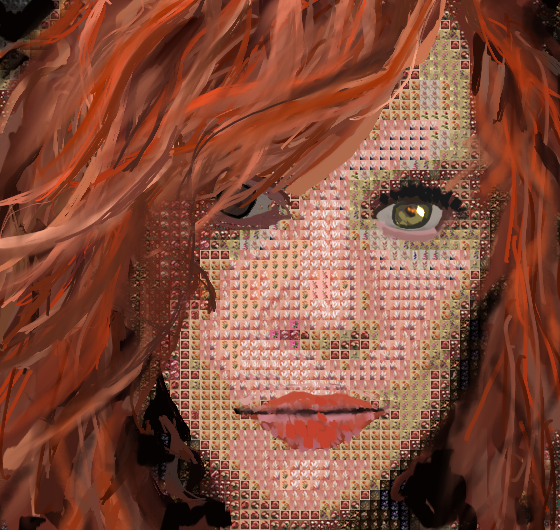
Process notes: I began with a photographic self portrait. I then created 700+ botanical images on solid color backgrounds, using Midjourney. I processed them using a Python photomosaic script (download), which divides the image into a fine grid, and analyzes average RGB values of each tile in the base image, before finding the closest corresponding image tile from the dataset for that portion of the portrait, constructing the portrait as a composite of hundreds of micro-images. The result is a dual-resolution system: from a distance, the image resolves into a coherent face; up close, it fractures into a dense archive of individual pictures. After generating the mosaic output, I digitally painted over portions of the image to reintroduce gestural brush strokes, creating tension between algorithmic assembly and painterly intervention.

Digitally constructed portrait of a woman composed of hundreds of tiny square images arranged in a grid to form her 
            face. From a distance, the image reads as a red-haired woman looking forward with one green eye visible; up close, the skin 
            is made of miniature repeating images in a tight mosaic pattern. Painterly red-orange brushstrokes in the hair contrast with 
            the rigid geometric grid across the face.

Sometimes I Fall Apart IV

Digital image, 2026
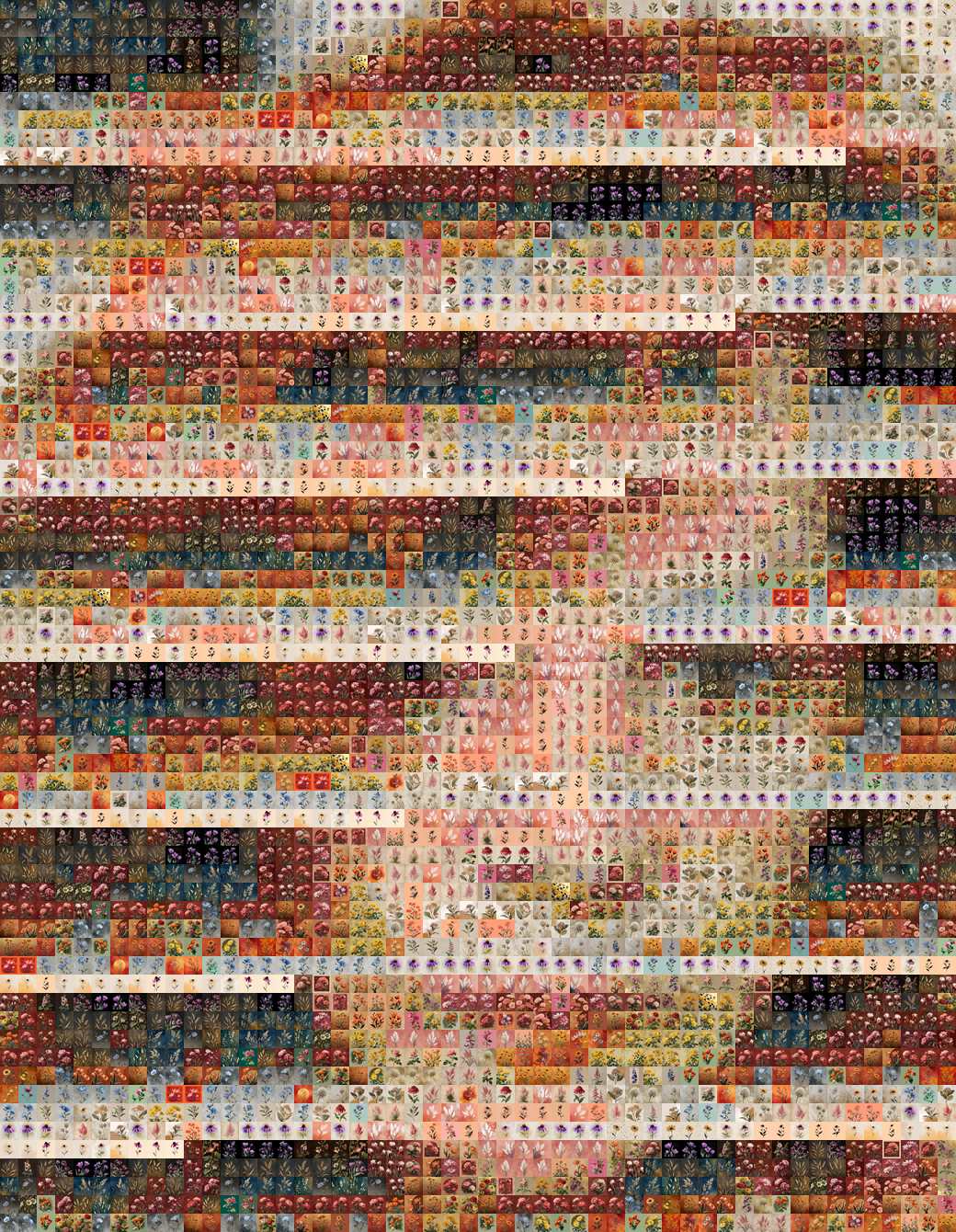
Process notes: This image comes from the same series that created the previous image. I adapted the Python photomosaic script slightly so that it would not re-use any images. The resulting image feels like a profound statement on my life with long COVID--waves of feedback preventing you from seeing me clearly.

Morning Roulette for the Chronically Ill

Digital image, 2026
I created this digital collage through a hybrid process combining digital layering and digital painting. I began by assembling found images then I painted directly onto the image to create the base structure of the watercolor vending machine and its colorful world. Then I layered multiple photographic source images into a composite structure. Rather than preserving the integrity of the original images, I treated them as raw material—cropping, masking, transforming and blending elements to create a fragmented visual field. I iteratively layered found images and painted directly onto the image with digital brushes to unify and disrupt the underlying layers. Throughout the process, I iteratively adjusted opacity, blending modes, and edge definition to balance cohesion and fragmentation. This piece visualizes chronic illness as a system governed by chance. The posterized fragments of bright neon areas represent moments of positive experience, but they’re flattened and simplified. Around them, the sepia imagery—more detailed, more persistent—represents the medical reality of life with an episodic disability.

Ask Me a Question, My Long COVID Will Answer

Digital image, 2026
I created this digital collage through a hybrid process combining glitch aesthetics, digital layering, and compositional montage. I began by assembling a range of found materials—digital error imagery, interface fragments, torn paper textures, and photographic elements—which I treated as raw visual data rather than fixed images. These components were cropped, distorted, and recombined to form a dense horizontal field that sits just above the figure’s head. Rather than maintaining clean separations between elements, I intentionally disrupted them through pixelation, compression artifacts, and color noise. I layered glitch textures and corrupted image data to break down visual continuity, allowing fragments of interface language (“ERROR,” “EXIT,” arrows, and signage) to emerge and collapse within the composition. This iterative process involved continuous adjustment of blending modes, opacity, and scale, as well as selective masking to create tension between sharp graphic edges and torn, organic forms.